
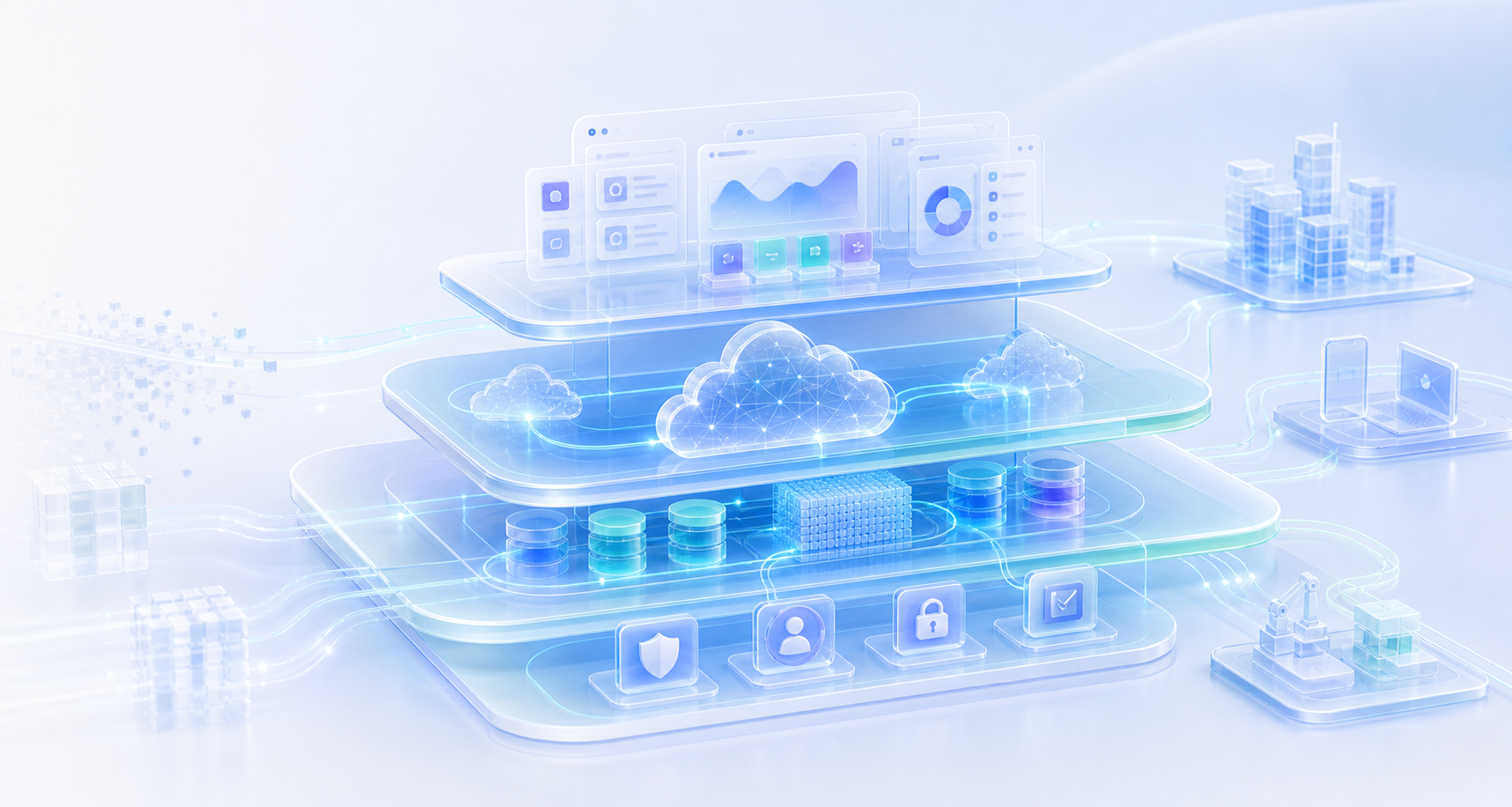
For years, modernization was mostly framed as a technical clean-up: replace legacy infrastructure, move workloads to the cloud, update the user interface, or integrate systems that had drifted apart. Those things still matter. But the AI era changes the center of gravity.
Modern enterprise systems now need to do more than store records and execute transactions. They need to make knowledge easier to use. They need to expose business context safely. They need to support automation without creating new operational risk. They also need to support AI where work actually happens: in the cloud, at the edge, on devices, and sometimes offline.
That shift has a practical implication: AI readiness is not only a model problem. It is a systems problem. The quality of an AI experience depends on architecture, identity, APIs, data quality, permissions, observability, device context, and the clarity of the workflow around it.
Enterprise Systems Need a New Operating Shape
Many organisations have systems that were built for a different rhythm of work. They were designed around forms, approvals, records, reports, and fixed process steps. That model can still be useful, but AI introduces a more fluid layer: users ask questions, generate summaries, trigger workflows, compare options, and expect software to surface the next best action.
To support that, systems need to become more composable. Business capabilities should be exposed through APIs. Data should be structured enough to retrieve and reason over. Identity should travel across applications consistently. User experiences should guide people through decisions, not just present fields.
This is why modernization cannot be reduced to a single migration project. It is a deliberate reshaping of the enterprise platform so that future capabilities can be added without starting from zero each time.
The Architecture Must Become More Adaptive
AI-era systems need architecture that can evolve. This does not always mean microservices or a full rebuild. It means creating clean boundaries, reducing fragile dependencies, and separating the parts of the system that change quickly from the parts that must remain stable.
In practice, that might mean modernizing a legacy application through an API layer before replacing the core. It might mean moving specific workloads to managed cloud services. It might mean rebuilding only the user-facing workflow while preserving the business rules that still work.
The important shift is from application thinking to platform thinking. A platform is not just one system. It is the set of capabilities, integrations, security patterns, and delivery practices that allow many systems to improve together.
Useful architecture questions
- Which capabilities should become reusable APIs?
- Where is the business logic that should be preserved?
- Which systems are blocking delivery speed or user experience?
- Where will AI features need safe access to data and actions?
Data Becomes Part of the Product Experience
In traditional enterprise systems, data often sits behind screens and reports. In AI-enabled systems, data becomes part of the interaction itself. Users expect to ask questions, receive explanations, generate documents, detect exceptions, and make decisions with more context.
That only works when data has structure, meaning, and access rules. If the underlying content is scattered, duplicated, stale, or poorly permissioned, AI will expose the weakness quickly. The answer is not to wait for perfect data. The answer is to design practical data paths for the use cases that matter most.
For example, a support AI assistant might need product documentation, ticket history, customer entitlements, and troubleshooting steps. A finance automation flow might need invoices, approval rules, vendor records, and audit trails. Each use case defines a data boundary, and modernization should make those boundaries easier to build and govern.
Edge AI and Offline AI Expand Where Intelligence Can Live
Not every intelligent experience should depend entirely on the cloud. Some work happens in stores, factories, branches, vehicles, field environments, kiosks, and user devices where latency, privacy, resilience, or connectivity constraints matter. In those cases, Edge AI and offline AI become part of the modernization conversation.
Edge AI can bring intelligence closer to the device or environment where action happens. Offline AI can keep important experiences available when connectivity is limited or when local processing is preferred. This is especially relevant for diagnostics, guided support, kiosk flows, device health, field operations, visual checks, local recommendations, and private user assistance.
The design challenge is deciding what should run locally, what should stay in the cloud, and how the two layers synchronize safely. A modern enterprise architecture should be able to support both: cloud-scale intelligence and local intelligence that works when the network is slow, unavailable, or not the right place to process sensitive context.
Security and Identity Move to the Center
AI raises the stakes for security because intelligent systems can summarize, infer, and act. That makes identity and access control even more important. Users should only receive answers, recommendations, or actions that match their role, context, and permissions.
Modern systems need consistent identity patterns, secure application sign-in, role-aware access, auditability, and clear separation between public, internal, and sensitive data. In Microsoft environments, Microsoft Entra integration is often a key foundation because it connects identity, application access, and enterprise governance.
Security should not be treated as a final review after the AI layer is built. It should shape the design from the beginning: what the system can see, what it can say, what it can do, and how humans stay in control.
The User Experience Shifts From Screens to Flows
AI changes the way users experience software. The interface is no longer only a place to enter data. It becomes a place to ask, compare, generate, approve, and resolve. This makes workflow design more important, not less.
A good AI-era workflow does not overwhelm the user with magic. It shows context, explains the recommendation, keeps important decisions visible, and lets people take action with confidence. It also respects the reality that many enterprise processes are collaborative: one person drafts, another reviews, another approves, and another monitors the outcome.
Modernization should therefore improve both the visible experience and the operating flow behind it. The goal is not simply to make the system more intelligent. The goal is to make the work easier to complete.
How to Sequence Modernization
The safest modernization programs do not try to change everything at once. They choose a meaningful workflow, modernize the foundations needed for that workflow, and then expand from there. This creates momentum without turning the whole organisation into a construction site.
A practical sequence often looks like this:
- Identify the workflows where AI or automation would create meaningful value.
- Map the systems, data, identities, and decisions involved in those workflows.
- Modernize the application or API boundaries needed to support the workflow.
- Strengthen cloud, security, observability, and deployment practices around it.
- Add intelligent features with evaluation, governance, and continuous improvement.
This approach turns modernization into a business capability. Each improvement makes the next one easier. Each workflow creates reusable patterns. Each platform decision reduces future friction.
The End State Is Not One System. It Is a Smarter Operating Layer.
The AI era rewards organisations whose systems can adapt. That does not mean chasing every new model or rebuilding every application from scratch. It means creating a digital foundation where applications, data, identity, cloud services, edge devices, offline experiences, and AI capabilities can work together safely.
Modern enterprise systems should be scalable enough for growth, intelligent enough to reduce friction, secure enough for sensitive work, and reliable enough to become part of daily operations. When those qualities come together, AI stops being a separate initiative and becomes part of how the organisation runs.
That is the deeper purpose of modernization: not newer technology for its own sake, but systems that help people and organisations work with more clarity, speed, and confidence.